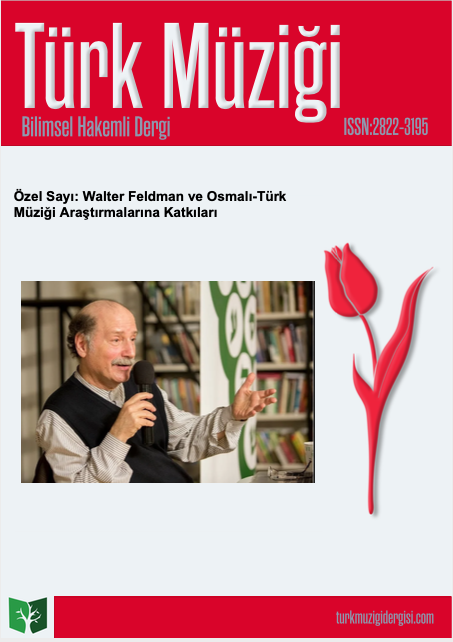
An examination of Walter Zev Feldman’s studies on Ottoman-Turkish music in terms of research practice, performance, and ınternational circulation
Keywords:
Walter Zev Feldman, Ottoman-Turkish Music, Bi-musicality, locally generated modernity, historical ethnomusicologyAbstract
This study examines how the scholarly and musical expertise developed through Prof. Walter Zev Feldman’s research and performance practice in Ottoman-Turkish music has been translated into concert performances, recordings, archival projects, publications, and educational activities through international collaborations. The central argument of the study is that Feldman’s work on Ottoman-Turkish music cannot be explained through a unidirectional model of transmission from Türkiye to the United States. Rather, his work is understood as a multifaceted process that developed through the reciprocal relationship between his intellectual orientation, shaped by his family roots, personal memory, and scholarly curiosity and grounded in the comparative study of different musical cultures, and the performance-based transmission tradition of Ottoman-Turkish music. Drawing on a historical documentary approach, the study examines Feldman’s published works and personal narratives alongside CD liner notes, concert programs, newspaper articles, institutional announcements, and the professional chronology published on his personal website. The historiographical approach evident in Feldman’s historical ethnomusicological research is examined through the concept of “locally generated modernity,” while his projects aimed at reconstructing historical repertoires from documentary sources and bringing them into performance are analyzed through the concept of “bi-musicality,” developed within American ethnomusicology. The findings indicate that the meşk (traditional master–apprentice musical instruction) and performance activities Feldman undertook with musicians such as Fatih Salgar, Hurşit Ungay, and Necdet Yaşar during his research visits to Türkiye beginning in 1969 played a decisive role in shaping his experience of performing across multiple musical cultures. This experience provides insight into Feldman’s theoretical and methodological orientations in historical ethnomusicology. Throughout his musical journey from the Bronx to the Bosphorus, the inward-looking and metaphysically oriented aesthetics he encountered in Ottoman court and Sufi lodge musical traditions enabled him to establish a new relationship with his own musical past and to reassess that heritage.
Author Biography
Zehra Tülin Değirmenci, Bağımsız

Dr. Zehra Tülin Değirmenci received her PhD in 2023 from the Department of Music and Performing Arts, Faculty of Art and Design, Yıldız Technical University, with a dissertation entitled “A Sociocultural Analysis of Hamparsum Musical Notation as a Sign System.” She completed her undergraduate and master’s degrees in the Department of Musicology at Dokuz Eylül University. She has served as a lecturer at Dokuz Eylül University, Süleyman Demirel University, Haliç University, and Yıldız Technical University. Between 1996 and 2006, she was the founding director of the Music Culture Research and Application Center at Süleyman Demirel University. During this period, she conducted field research documenting the musical culture of the Teke region and established an audiovisual archive and a musical instrument collection. From 2023 to 2025, she continued her research as a Visiting Scholar at the Center for Middle Eastern Studies (CMES) at Harvard University. She also pursued advanced English language studies at Boston University’s Center for English Language & Orientation Programs. Since 2024, she has contributed concert reviews and critical evaluations of performances she has attended in the United States to her column entitled “Concert Notes” in Konser Arkası magazine. Her research focuses on historical musicology and musical paleography, with particular emphasis on Hamparsum manuscripts and the Hamparsum notation systems
Published
How to Cite
Issue
Section
License
Copyright (c) 2026 Türk Müziği

This work is licensed under a Creative Commons Attribution-NonCommercial-NoDerivatives 4.0 International License.


