
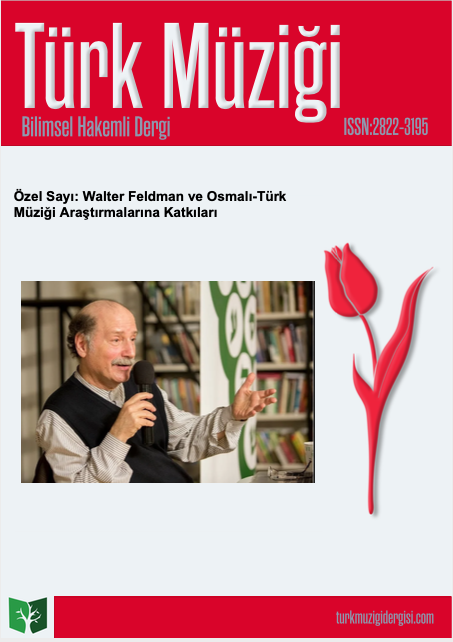
From Walter Feldman to the Eastern Mediterranean: Toward an intellectual history of musical knowledge in Ottoman-Turkish music historiography
Keywords:
Byzantine music theory, Eastern Mediterranean, Music historiography, Ottoman-Turkish music, Walter FeldmanAbstract
This article approaches Walter Feldman’s contribution to Ottoman-Turkish music historiography not only through the sources he employs and the historical knowledge he brings to light, but also through a research practice that broadens the ways in which the field formulates its questions. Feldman’s major studies on Ottoman music, together with selected literature on Byzantine, medieval Islamic, post-Byzantine Greek Orthodox, and Ottoman theoretical traditions, are examined in terms of the diversity of sources and actors, the relationship between theory and practice, multilingualism, philological transmission, conceptual reproduction, and the circulation of musical knowledge. Feldman’s work demonstrates an understanding of Ottoman music as a field historically constituted and transformed through the combined consideration of manuscripts, notations, repertoires, institutions, performance practices, and actors from different communities. From this perspective, the Eastern Mediterranean is approached not as a homogeneous cultural whole, but as a historiographical scale within which relations among different theoretical and intellectual environments can be investigated over the longue durée. In the literature examined, debates over origins and belonging, comparisons between makam and ēkhos and between theoretical systems, as well as studies of notation, repertoire, archives, and multilingual transmission emerge as distinct lines of inquiry. The article proposes reconsidering this body of scholarship within the framework of an “intellectual history of musical knowledge,” asking how theoretical problems were transmitted, transformed, and reconceptualized across different textual, linguistic, pedagogical, and institutional settings. The Harmonika of the Late Byzantine music theorist Manuel Bryennios demonstrates the possibilities of this approach through theoretical problems encountered in Byzantine classical harmonic science and medieval Islamic music theory. The comparison does not seek to establish an uninterrupted chain of transmission from Byzantium to the Islamic world or to Ottoman music theory. Instead, it considers how the research horizon opened by Feldman might be extended toward a longer-term intellectual history of musical knowledge in the Eastern Mediterranean. In doing so, it seeks to bring transformation, divergence, and reconceptualization, alongside continuity, into the research problems of Ottoman-Turkish music historiography.
Published
How to Cite
Issue
Section
License
Copyright (c) 2026 Türk Müziği

This work is licensed under a Creative Commons Attribution-NonCommercial-NoDerivatives 4.0 International License.


