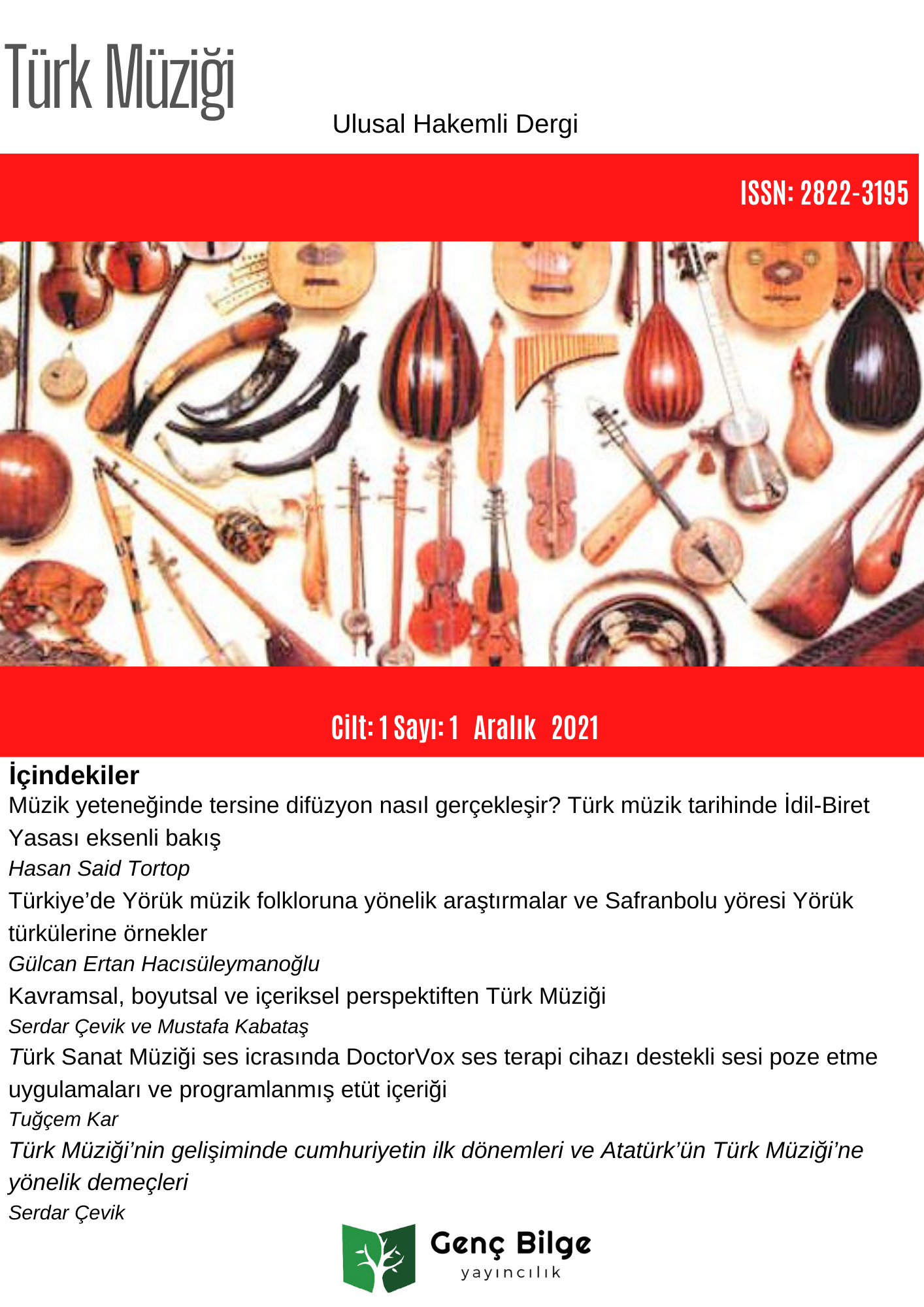
Voice posing practices and programmed etude content in Turkish Classical Music voice performance with the DoctorVox voice therapy device
Keywords:
Turkish music school, vocal performance features, Doctorvox singing therapy, modal exercise, etude contentAbstract
This study was carried out to contribute to the formation of Turkish classical music singing school. Turkish classical music is a special field that requires the acquisition of different qualifications during the education period in terms of attitude and performance characteristics. Since the aim is to transfer traditional Turkish music performance and attitude characteristics to future generations in a conservative way, it is important to conduct scientific studies and create a methodology for this field. Until the establishment of Turkish music conservatories, the learning process was carried out with the method of “meşk” within the framework of the master-apprentice relationship in music societies. Today, both musical societies, associations and Turkish music conservatories continue these trainings. In some Turkish music conservatories, vocal training and repertoire lessons are carried out separately, and in the correpetition lessons, under the supervision of repertoire and singing faculty members, the students are given suggestions in terms of technical and performance characteristics, while this education is carried out only within the scope of repertory lessons in some Turkish music conservatories. While voice educators, usually from classical western music, who specialize in vocal education, conduct their lessons by applying basic vocal exercises with the piano, it is also known that in some conservatories, educators of Turkish music origin specializing in the field of Turkish music repertoire make voice exercises with the Turkish music instrument they are playing and then practice the works. Some Turkish music conservatories are against giving voice training with piano. The reason for this is that there are no microtonal sounds in the piano and that exercises can be done in the tampered system. The voice education student needs an education system that also develops modal voice. Voice training should be created in a holistic structure that also includes the features of the taught repertoire. The voice technique used during the performance should be created based on our natural voice, it should be healthy and sustainable. In order for the student to gain all these requirements and competencies, body-mind-emotion must be trained together and the voice trainer must have a command of the physiological system that will realize the style features. In line with these considerations, developed from laxvox, which Dr. İlter Denizoğlu produced with great effort for voice therapy and vocal therapy at the Vocology Center, DoctorVox device is included in the training process. In addition to general vocal therapy practices, modal exercise and work system are given in the study in order to improve Turkish music style, features and modal pitches.
Downloads
Published
How to Cite
Issue
Section
License
Copyright (c) 2023 Türk Müziği

This work is licensed under a Creative Commons Attribution-NonCommercial-NoDerivatives 4.0 International License.


