
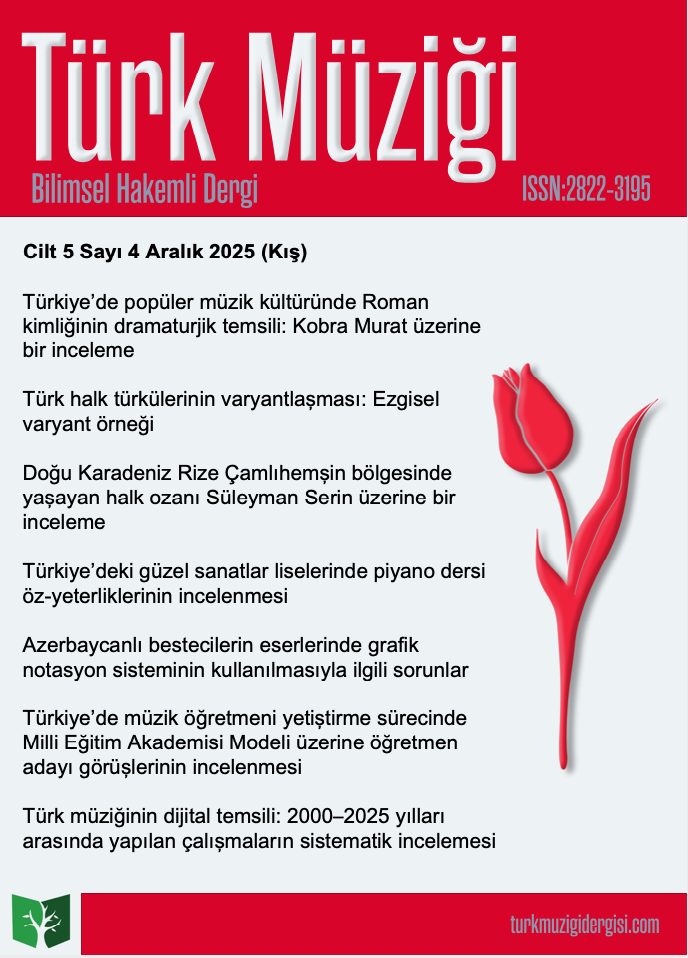
An examination of the folk poet Süleyman Serin Living in the Eastern Black Sea Region of Rize–Çamlıhemşin
Keywords:
Baglama, Süleyman Serin, Turkish Folk Music, Rize-ÇamlıhemşinAbstract
The Eastern Black Sea region has historically attracted the interest of numerous civilizations due to both its natural beauty and strategic importance, thereby becoming a crossroads of diverse cultures. Influenced by this rich historical and geographical heritage, local communities have developed distinct cultural identities, which have left lasting marks on the region’s social structure over time. This study aims to examine the musical career, works, and contributions of the folk poet Süleyman Serin, who resides in the Eastern Black Sea region, to the music of the area. Süleyman Serin’s work on the construction and performance of the tulum and bağlama, as well as his compositional activities, demonstrate his significant contributions to the region’s musical culture. Moreover, the young musicians he has trained and the tulum workshop he established are considered to play an important role in preserving the cultural heritage of the region. The study addresses the place of Serin’s compositions and instruments within Black Sea culture, his role as a source person (kaynak kişi), and his contribution to the transmission of regional music to younger generations. Throughout his musical life, Serin has been influenced by master musicians such as Neşet Ertaş and Sabit Karaman, and it is observed that he combines the traditional structures of the tulum and bağlama with modern musical elements while preserving their authenticity. The research was conducted using a phenomenological approach, employing semi-structured interviews and fieldwork. Within the scope of the study, one of Süleyman Serin’s orally transmitted works was compiled and transcribed into musical notation. Analysis revealed that this piece was composed in the Neva makam and in the Türk Aksağı (5/8) rhythmic pattern. The lyrics of the work address themes related to the concept of family. These findings not only bring Süleyman Serin’s contributions to Eastern Black Sea music to scholarly attention for the first time but also highlight the importance of incorporating his orally transmitted composition—through musical and technical analysis—into performance repertoires within educational institutions.
Author Biography
Serap Duran Subatan

Dr.Öğr.Üyesi Serap Duran Subatan, Sivas’ta dünyaya gözlerini açan Subatan, Lisansını Cumhuriyet Üniversitesi –Güzel Sanatlar Fakültesi, Müzik Bölümü, Müzikoloji Anasanat Dalında (2005-2009) hem fakülte hem bölüm birincisi olarak bitirdikten sonra master eğitimini Cumhuriyet Üniversitesi –Güzel Sanatlar Fakültesi, Sosyal Bilimler Enstitüsü Müzikoloji Bölümünde (2009-2012) Türk Mûsîkîsi alanı üzerinde birincilikle tamamladı. Yurtiçi ve yurtdışı konferans, sempozyum, seminerlere katılarak, ulusal genç solist şan yarışmaların yanısıra Türkiye çapındaki Ulusal ve Uluslararası sanatçıların masterclasslarına ve bir çok yarışma jüriliklerinde görev almış; yerli yabancı orkestralar eşliğinde çok sayıda solo konserler vermiştir. Piyano, Tanbur ve Viyola enstürmanlarına da hâkim olan akademisyen/sanatçı Subatan, 2016-2017 Eğitim-Öğretim yılında Ankara Hacı Bayram Veli Üniversitesi Türk Müziği Devlet Konservatuvarında doktora programına birincilikle başlayıp ileri düzeyde Osmanlıcaya hâkim olmakla birlikte, Ses Eğitimi Psikolojisi ve Klâsik Türk Müsikisi Ses İcracılığı alanında doktorasını 2023 yılında bitirmiştir. Ses Eğitimi, Müzikoloji ve Türk Müziği alanlarında bilimsel araştırmalarını sürdürmektedir. Şuan Sivas Cumhuriyet Üniversitesi, Eğitim Fakültesi, Güzel Sanatlar Eğitimi Müzik Anabilim Dalında 2009/-halen Ses Eğitimi alanında öğretim elemanı olarak çalışmaktadır
Kurum: Müzik Bölümü, Güzel Sanatlar Eğitimi ABD, Eğitim Fakültesi, Sivas Cumhuriyet Üniversitesi, Sivas, Türkiye. Email: duran.se@gmail.com ORCID: 0000-0002-5331-2732
Downloads
Published
How to Cite
Issue
Section
License
Copyright (c) 2025 Türk Müziği

This work is licensed under a Creative Commons Attribution-NonCommercial-NoDerivatives 4.0 International License.


