
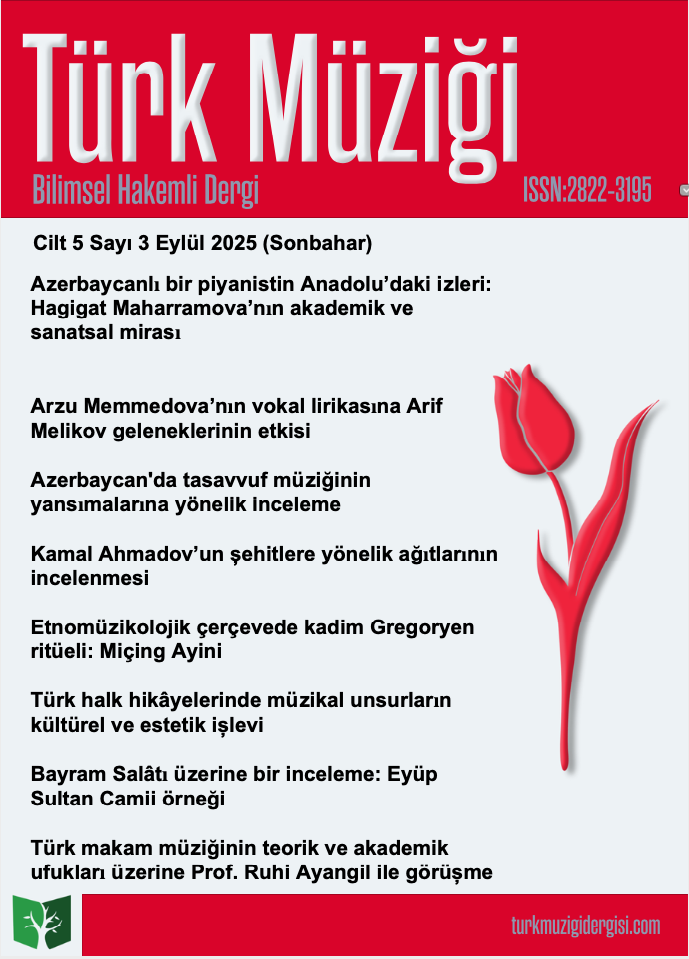
An interview with Prof. Ruhi Ayangil on the theoretical and academic horizons of Turkish Makam Music
Keywords:
Conservatory education, makam, rhythmology, Turkish Makam Music, usulAbstract
In this interview, Prof. Ruhi Ayangil discusses the theoretical, historical, and academic dimensions of Turkish makam music. The conversation first emphasizes that the concept of usûl is not merely a rhythmic structure but also an intellectual and aesthetic foundation; the transformation of usûl is examined within a historical context stretching from ancient Greek meters to Ottoman aruz prosody. The performance of Mevlevî rituals and Sufi music is evaluated within the tension between mystical tradition and academic representation, while the shortcomings and methodological issues of modern conservatory education are highlighted. The institutionalization of traditional music during the Republican era is critically addressed through debates on the narrowing of repertoire and meritocracy, with a call to restore high-quality repertoires to a central role in education and performance practices. Current directions in Turkish makam music research are redefined along the axes of organology, rhythmology, and musicology, and new conceptual and archival research fields are suggested for young scholars. Prof. Ayangil stresses the importance of independent and collective research activities—exemplified by the Turkish Makam Music Academic Circle (TUMAC)—and underlines the need for a comprehensive encyclopedia of Turkish makam music to be prepared with an interdisciplinary perspective. In this respect, the interview offers a significant discussion of the theoretical foundations, performance traditions, and academic representations of Turkish makam music from past to present.
Author Biography
Orkun Zafer Özgelen, İstanbul Teknik Üniversitesi

Orkun Zafer ÖZGELEN. müziğe bağlama çalarak başladı ve 2000 yılında lisede İTÜ Türk Müziği Devlet Konservatuarı Çalgı Eğitim bölümünü, ardından 2004 yılında lisansta İTÜ Konservatuarı Kompozisyon bölümünü kazandı. Erol Sayan ile repertuar, Faris Akarsu ile piyano, kompozisyon ve teori, Nail Yavuzoğlu ile armoni, teori, Oğuzhan Balcı ile kompozisyon, Feridun Öney ile Türk makam müziği, Neşe Yeşim Altınel Çoban ile form bilgisi çalıştı. 2008’de Erasmus bursuyla İtalya, Roma, Conservatorio di Santa Cecilia’da iki sene Orkestrasyon ve Kompozisyon dersleri aldı. 2010 yılında İTÜ Müzikal Topluluğu’nu kurdu. Bu devrede birçok festival ve davetlerde etkinlik ve konser düzenledi. Bu toplulukta kurucu şef olarak hizmet etmenin ardından, 2015 yılında Koç Üniversitesi Müzikal Topluluğu’ndan davet alarak bir sene bu topluluğa müzik direktörlüğü ve eğitmenliği yaptı. Oscar Wilde’ın “Dorian Gray’in Portresi” adlı romanının müzikal adaptasyonu olan ‘Dorian’ isimli müzikalin düzenlemesini ve müzik direktörlüğünü yaptı. 2021 yılında Doç. Şerife Güvençoğlu ile hazırladığı Türk Makam Müzikçisinin Seyir Defteri I adlı kitabı Pan Yayıncılık tarafından yayınlandı. 2023 yılında basılan Dr. Öğr. Üyesi Funda Esin ile Türk Makam Müziği’nden Esintiler adlı albümde aranjör ve piyanist olarak yer aldı. 2023 yılında Nebi Birgi tarafından yazılan ‘The Diva’ müzikalinin müziklerini besteledi. 2024 Şubat ayında İTÜ Müzikoloji ve Müzik Teorisi programından mezun olarak doktor ünvanını aldı. 2025 yılında Hüseyin Sadeddin Arel ve Bir Musiki Masalı adlı kitabı Eğitim Yayınevi tarafından basıldı. Hali hazırda İTÜ Türk Müziği Devlet Konservatuarı’nda akademisyen olarak görev yapmaktadır.
Downloads
Published
How to Cite
Issue
Section
License
Copyright (c) 2025 Türk Müziği

This work is licensed under a Creative Commons Attribution-NonCommercial-NoDerivatives 4.0 International License.


