
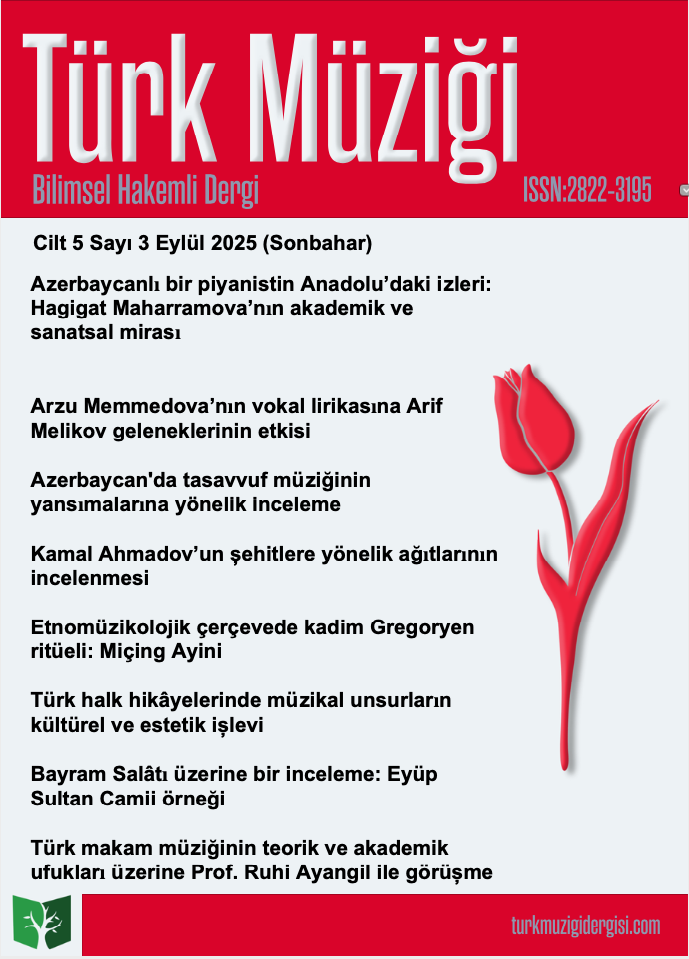
he ancient Gregorian ritual in an ethnomusicological context: The Michink Rite
Keywords:
Church, Maqam Music, Michink Rite, Armenian, PataragAbstract
The article, which is based on a case study design, examines the Michink Rite, which is performed once a year in Kayseri Surp Krikor Lusavoriç Church (1191), the first Apostolic Armenian church in Turkey, within an ethnomusicological framework. For Gregorian Armenians, Kayseri represents their ancestors and a sacred place. This sacred visit is similar to the “pilgrimage” called ukhtagnatsutyun (ուխտագնացություն). The meaning/significance of Miçing and the ritual of communion form the philosophical background of the study. The ritual takes place during the great fasting period of Gregorian Christians and is basically the performance of the Surp Badarak (Divine Liturgy), which has taken its current form with some modernizations and the ancient transmission of the centuries-old Anatolian Armenian Gregorian community. The data for the findings were obtained through observation, camera recordings and interviews. The liturgical repertoire was followed through the polyphonic notation arranged by Gomidas Vartabet, dictated through the Arel-Ezgi-Uzdilek theoretical understanding/structure, and rewritten in accordance with makam tones. The notation of recitative performances has been obtained solely through dictation. It has been understood that Hicaz, Hüzzam, Rast, Segâh, Acem and Buselik maqams are used throughout the liturgy, and especially in the recitative performances, traditional/maqam melodic constructions are included, different from Gomidas' plain standardization.
Downloads
Published
How to Cite
Issue
Section
License
Copyright (c) 2025 Türk Müziği

This work is licensed under a Creative Commons Attribution-NonCommercial-NoDerivatives 4.0 International License.


