
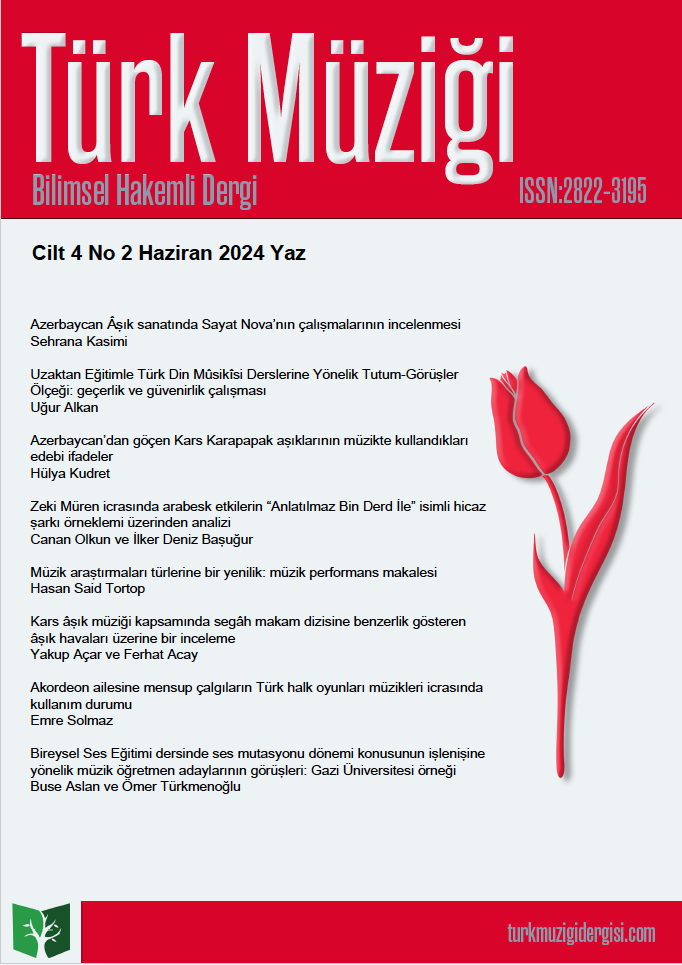
Music teacher candidates' opinions on the teaching of the topic of the voice mutation period in the Individual Voice Training course: The case of Gazi University
Keywords:
Individual Voice Training course, music teacher candidates’ opinions, program evaluation, voice mutation periodAbstract
The training of music teachers can be further developed with the updating of current curricula. The Individual Voice Training course is one of the important courses in terms of its content, and the topic of voice mutation is included in the curriculum. In this study, the researchers addressed the topic of voice mutation and gathered evaluations from music teacher candidates. The research is a case study, which is one of the qualitative research types. In the study, 47 students from the Department of Music Education at Gazi University in the 2023-2024 academic year were selected as participants due to the convenience and cost-effectiveness of the application. The Opinions on the Mutation Period in the Individual Voice Training Course Scale was used to determine the participants' evaluations of the handling of the voice mutation topic in the Individual Voice Training Course. This scale consists of eight items and is a Likert-type scale. The reliability coefficient of the scale was determined to be .931. The Chi-square test was used in the analysis of the data. As a result of the research, the items showing differentiation in the participants' opinions were in the dimensions of the importance of emphasis, the adequacy of content, comprehensibility, and the adequacy of course duration (p<.05), while there was no differentiation in the dimensions of the encouragement of research, adequacy of source materials, emphasis on importance for vocal health, and information provision (p>.05). The level of agreement with the statements about the handling of the voice mutation topic by the participants was at a moderate level ( = 2.97). The highest level of agreement in the sub-dimensions was in the dimension of Emphasis on Importance for Vocal Health ( = 3.21), and the lowest level of agreement was in the dimension of Adequacy of Source and Materials ( = 2.72). There was no differentiation in the participants' opinions according to age and gender (p>.05). Based on the participants' opinions, studies can be conducted to improve the course program. In-depth interviews and observations can be conducted.
Author Biographies
Buse Aslan, Gazi Üniversitesi

Buse Aslan 2018’de Uludağ Üniversitesi Müzik Eğitimi Anabilim Dalı’nda lisans öğrenimini tamamladı. 2018 yılından beri Milli Eğitim Bakanlığı’na bağlı okullarda müzik öğretmenliği yapmaktadır. 2021 yılında Gazi Üniversitesi Eğitim Bilimleri Enstitüsünde Yüksek Lisans çalışmalarına başlamıştır. Yüksek Lisans çalışmalarını halen sürdürmektedir.
Academia: https://independent.academia.edu/BuseAslan28
Researchgate: https://www.researchgate.net/profile/Buse-Aslan-5
Ömer Türkmenoğlu, Gazi Üniversitesi

Prof. Dr. Ömer Türkmenoğlu, 1995 yılında Bilkent Üniversitesi Müzik ve Sahne Sanatları Fakültesi Şan Sanat Dalı’na girdi. 2003 yılında İtalya’da Imalatesta Yaz Akademisi’nde bariton Alessandro Calamai ve Mauro Trombetta ile çalıştı. 2010 yılında ABD Indiana Üniversitesi’nde Post Doktorasını ünlü tenor Carlos Montane ile yaptı. 2012’de Bilkent Üniversitesi Müzik ve Sahne Sanatları Fakültesi Şan Opera Bölümü’nden Sanatta Yeterlik derecesini aldı. 27 Şubat 2017 tarihinde doçentlik unvanını aldı. Halen Gazi Üniversitesi Eğitim Fakültesi Güzel Sanatlar Eğitimi Bölümü Müzik Anabilim dalında Profesör olarak görevini sürdürmektedir.
Kurum: Gazi Üniversitesi Eğitim Bilimleri Enstitüsü, Güzel Sanatlar Eğitimi Anabilim Dalı, Müzik Eğitimi Bilim Dalı, Ankara, Türkiye. Email: omerturkmenoglu@gazi.edu.tr ORCID: 0000-0002-2539-3600
Downloads
Published
How to Cite
Issue
Section
License
Copyright (c) 2024 Türk Müziği

This work is licensed under a Creative Commons Attribution-NonCommercial-NoDerivatives 4.0 International License.


