
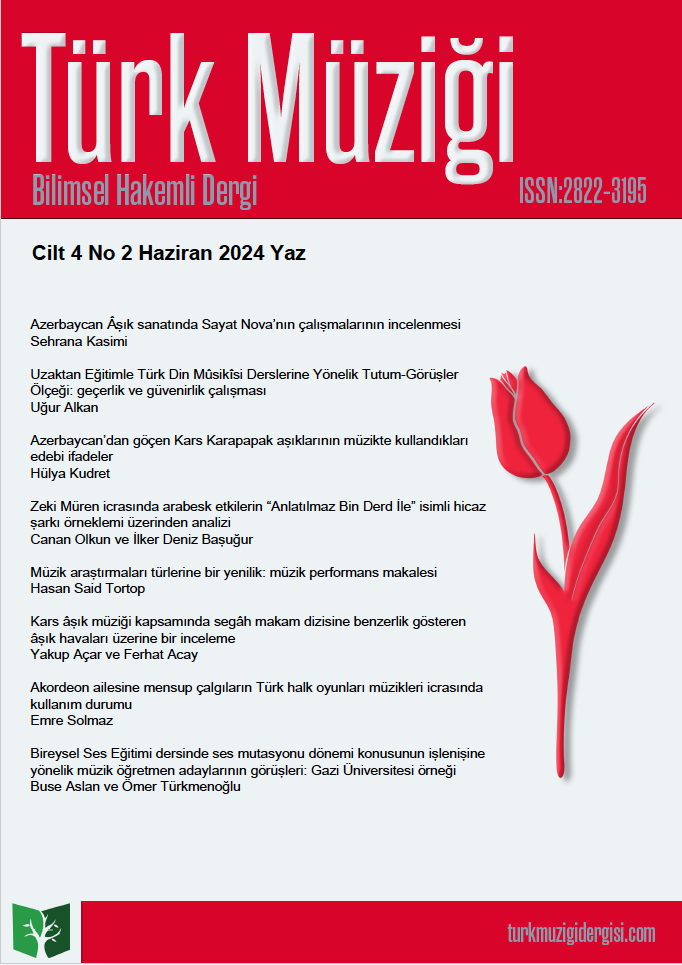
Examination of minstrel patterns similar to the Segâh makam scale within the scope of Kars Minstrel Music
Keywords:
Kars minstrel tradition, minstrel musics, segâh maqam scaleAbstract
Turks have adopted a nomadic lifestyle throughout most of their lives, kept their culture alive in every geography they existed in, and interacted with the cultures they encountered. One of the most important cultural phenomena that the Turks have preserved and maintained until today is the oral culture tradition. The tradition of minstrelsy and its performers, the minstrels, have protected the Turkish musical culture as well as Turkish folk literature by transmitting the oral culture tradition through the master-apprentice relationship. It is possible to say that the tradition of minstrelsy in Turkish culture was first seen in Anatolia when the Turks entered the city of Kars-Ani in 1064. Because it is a starting point and has internalized this tradition, the city of Kars is still a city where it preserves and transmits all the facts of the minstrelsy tradition. In the minstrelsy tradition, the musical element is as important as the lyrics element. Minstrel pieces are performed with melody and the accompaniment of an instrument. In the Kars minstrelsy tradition, the works are based on the content, events, people, etc. It is performed in different melodic patterns depending on the situation and each is called a different maqam. In this research, the minstrel maqams used within the scope of minstrel music in Kars province were examined. Among the minstrel maqams, 30 minstrel maqams that are similar to the Segâh maqam scales have been identified. These minstrel moods were analyzed in terms of form, flow, rhythm, sound width, tempo, element that determines the maqam, theme and story. As a result of the analysis, the degree of similarity of the maqams to the Missing Segâh and Segâh maqam scales and the distinctive features of each maqams were tried to be revealed.
Author Biographies
Yakup Açar, Kafkas Üniversitesi Dede Korkut Eğitim Fakültesi, Güzel Sanatlar Eğitimi Bölümü, Kars, Türkiye

Doç. Dr. Yakup Açar, halen Kafkas Üniversitesi Dede Korkut Eğitim Fakültesi’nde çalışmaktadır. Mezuniyetleri şu şekildedir. Atatürk Üniversitesi Güzel Sanatlar Fakültesi/Müzik Bilimleri Bölümü/ Atatürk Üniversitesi Sosyal Bilimler Enstitüsü/Müzikoloji (YL) (Tezli). İnönü Üniversitesi Eğitim Bilimleri Enstitüsü/Müzik Eğitimi (Dr). Açar, müzikoloji, Türk halk müziği, âşıklık geleneği ve etnomüzikoloji gibi alanlarda akademik çalışmalar yürütmesinin yanında Türk halk müziği dinleti ve konserlerinde şef, bağlama icracısı, solist ve korist olarak görev almaktadır. Kurum: Kafkas Üniversitesi Dede Korkut Eğitim Fakültesi, Kars, Türkiye. E-mail: yakupacar8@hotmailcom ORCID: 0000-0001-8682-6396
Google Akademik: https://scholar.google.com/citations?user=z1bhnjgAAAAJ&hl=tr&oi=ao
Academiaedu: https://kafkas.academia.edu/YakupAÇAR
ResearchGate: https://www.researchgate.net/profile/Yakup-Acar-2
Ferhat Acay

Bilim Uzmanı Ferhat Acay, Müzik Bilimleri alanında yüksek lisansını tamamlamıştır. Mezuniyetleri şu şekildedir. Kafkas Üniversitesi Devlet Konservatuvarı/Geleneksel Türk Müziği Bölümü/ Atatürk Üniversitesi Güzel Sanatlar Enstitüsü/Müzikoloji (YL) (Tezli). Acay, Türk halk müziği, müzik kültürü ve âşıklık geleneği ile ilgili çalışmalar yürütmekte ve çeşitli Türk halk müziği topluluklarında bağlama icracısı, solist ve korist olarak görev almaktadır. Kurum: Atatürk Üniversitesi Güzel Sanatlar Enstitüsü, Müzikoloji Tezli Yüksek Lisans Programı, Erzurum, Türkiye. E-mail: ferhat.acay36@gmail.com ORCID: 0000-0002-1417-8075
Academiaedu: https://kafkas.academia.edu/FerhatAcay?nbs=user
Downloads
Published
How to Cite
Issue
Section
License
Copyright (c) 2024 Türk Müziği

This work is licensed under a Creative Commons Attribution-NonCommercial-NoDerivatives 4.0 International License.


